The Feel of Morocco
The Feel of Morocco
Inshallah
“The Feel of Morocco”
During our first months in Europe, church bells rang every hour, reminding us of time. As we crossed into Morocco, the bells ceased and were replaced by strange voices heard from mosque loudspeakers five times a day. With no blocks in the calendar to fill the spaces in between, time had slowly begun to escape us in our next-chapter life. I became more present to my body and how it felt to be anchored in time and space, instead of living by schedules that once defined time for us.
It was hard to hear the Adhān and not become more aware of our existence within time and space — and even deeper, to ponder its connection to something greater, as the call to prayer suggests. During our months in Morocco, we traveled through remote deserts and villages to the largest cities in the country, and not one day was there an absence of this call.
Something I’ve appreciated about our time in Morocco is the silence, space, and slowness manifested by Morocco’s many cultural and societal layers. One layer, I learned, includes a system called the Moroccan model of moderate Islam, which integrates Islamic jurisprudence (Islamic law), Ashʿari theology (Islamic belief system), and Sufi spirituality. A fourth component is a revered monarchy that helps ensure moderation in the religious order. To make things even more interesting and textured, Moroccan culture is still heavily influenced by the animistic values of the ancient Amazigh people from before the Common Era.
Being in the slow-paced, spiritual, and more embodied culture of Morocco made us realize how easy it was to get lost within an American value system built around an external locus of control — and to lose awareness of the here and now, as well as the truly important things in life, like kindness, love, and a sense of belonging.
As we straddled two seemingly different worlds, I questioned even more the meaning of life, morality, and happiness. Many times during the month of Ramadan, I thought, “Wow, we are exploring this country while the entire country is praying, fasting, and working hard to feed their families — all the while displaying sincere humility, gratitude, and acceptance.”
I also thought about how our country — the richest nation in the world — and other countries are waging wars when the global GDP already produces enough to support the basic needs of the world’s entire population.
I also thought about what is considered power. There are many forms of power — including the power of prayer, kindness, and presence — which many Moroccans exemplified.
During Ramadan, Moroccans fast until the evening and restrain from things that create distraction. It is a month of purification. At the end, they make peace with all those with whom they’ve had conflict in the past. I thought, if we are all connected, as I believe we are, I imagine the collective gain produced for all humanity — similar to thousands of monks meditating for long periods of time. And here in Morocco is an entire country living a version of just that.
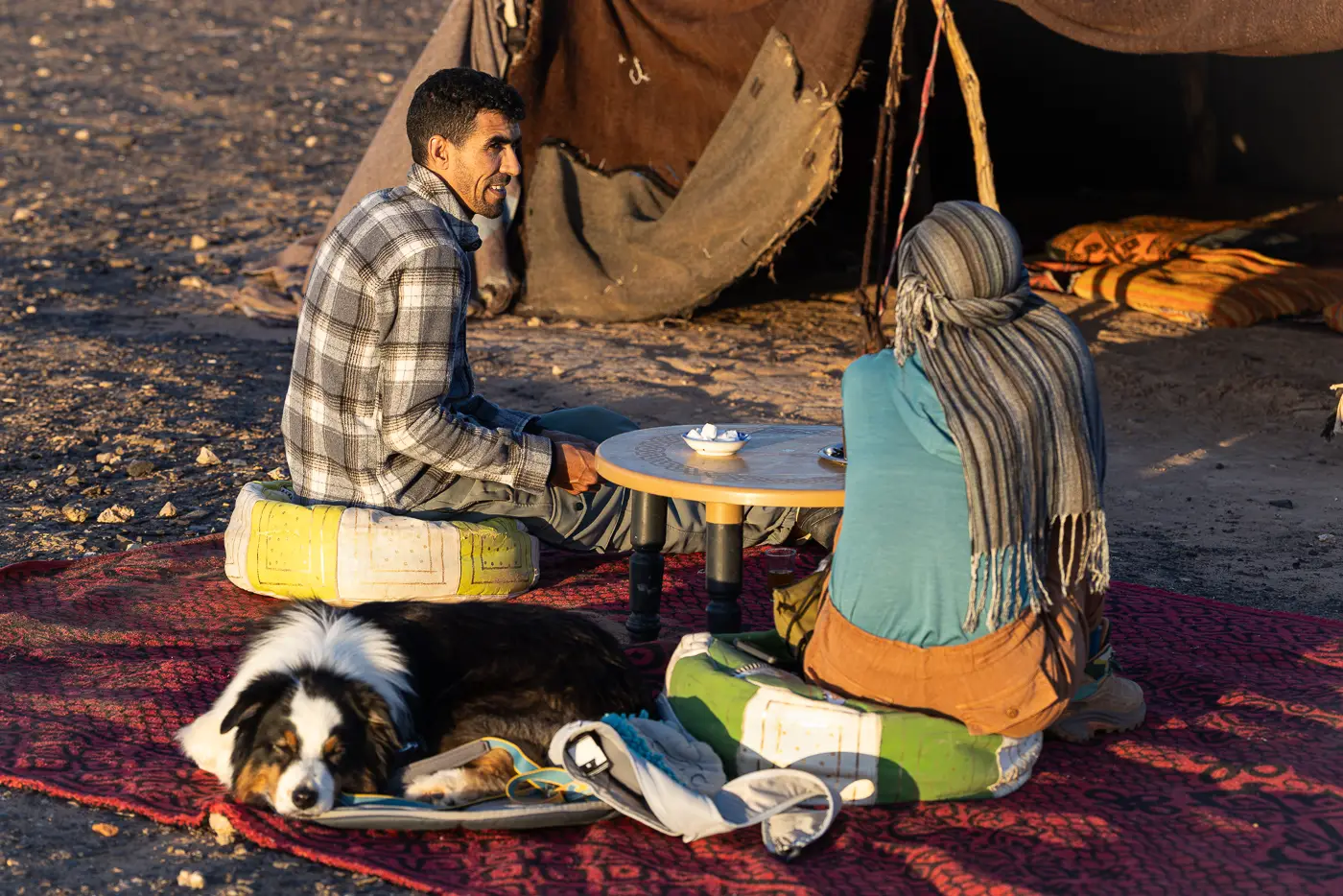
During our time in the Sahara Desert, Hassan — a man who grew up in a lineage of Berber nomadic families (more in Karl’s visual story) until his family moved into a village when he was fourteen — guided us through remote desert regions and nomadic communities. When I asked him what he had discovered from the two different ways of life, he replied:
“As a nomad, you have no worries. You are free. You don’t have to worry about much except where the animals will feed. You are just living. It’s not an easy life, but it’s peaceful.”
He added,
“But you don’t get to have an education.”
He continued,
“Living in the village, the people are stressed all the time about money — ‘How are we going to get more?’ — and then they stress about little things too. And then they want more things.”
He added again,
“But in the village, you get an education… which gives you a job and you can do more.”
I posited that there are different kinds of knowledge (and intelligence), like the kinds acquired living and surviving from the land. He cocked his head inquisitively and thought hopefully for a moment, but then decided not to buy it.
Interestingly, for Hassan, it was the particular kind of freedom and peace in a nomadic life versus an education and money — a different kind of freedom and peace. A good example of how things change and tend toward common behaviors when civilizations advance and grow in numbers.
We noticed this in the bigger cities, where modernization was integrated into the culture. It was a huge juxtaposition between moderation and materialism coexisting with one another. But the cities did not represent the majority of the country.
The Feel of Morocco
Morocco combines religion, jurisprudence law, and spirituality with several other components that, in our experience, created the most unique and laid-back, peaceful culture we have yet to experience in our lifetimes. Everywhere we went, we heard people saying “Inshallah,” which means God willing — an acceptance that ultimately we have no control. We also heard “Marhaba,” which means you are welcome. Not “you are welcome because I gave you something,” but “You are welcome here — and now. You belong here.”
Relationship was prioritized over time, and business and we experienced this in all matters of exchange.
I am not a religious person, but I do consider myself a spiritual person. And I believe that when we become aware of something greater, as the Adhān suggests, we forget ourselves and are reminded of others — and of how we are all connected. And that we all belong.
So when I find myself grappling with the inequity, inequality, and imbalance in the world, as I often do during our travels, I remind myself: “Inshallah.” I take a deep breath and send love, kindness, and compassion to all existence. It does not remove me from my responsibility to humanity, but it is the single most powerful thing I can do in the moment.
As a traditional Sufi saying often attributed to al-Ghazali puts it:
“There are as many paths to God as there are breaths of human beings.”
And as another guide said to us during our time in Morocco:
“We can’t change the world. All we can do is be happy and be present in the moment.”
Inshallah. Marhaba. You are welcome here.
Glamour Overland
The Feel of Morocco
The Heart(beat) and Soul of Spain
¡OLÉ!
A Romance with France
The Happy End(ing)

Comments are closed.
adventure.wolves